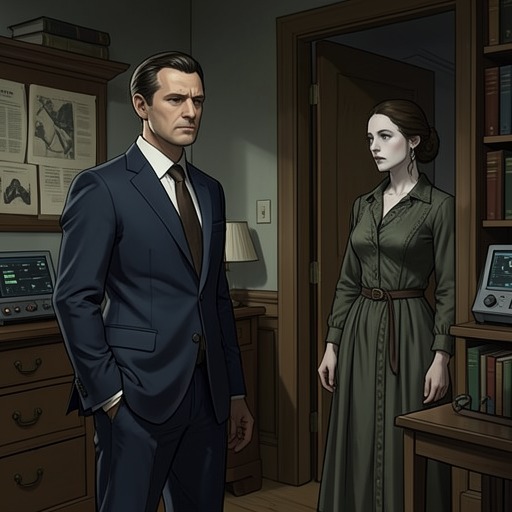
“I’m a good liar”
The Girl on the Train“I’m a good liar” is Tom Watson’s self-description, first recalled by Anna Watson as part of their affair and later repeated by Rachel Watson during the confrontation that brings their separate knowledge of his betrayals together. The phrase matters because it is both a boast and a warning: Tom presents deception as a talent, while the women around him discover how effectively that talent has made them doubt what they know.
The Boast in the Affair
Anna remembers the phrase while taking Evie shopping after Tom leaves for work. Their route passes 34 Cranham Street, where Anna and Tom used to meet. The house brings back the clandestine routine: Anna hurried up the steps, hoped the neighbours would not see her, got ready in the bathroom, and waited for Tom to arrive. They would spend an hour or two together upstairs. The remembered line belongs to this concealed arrangement, not to an abstract conversation about honesty.
Anna had asked whether Tom worried that Rachel would check up on him. He dismissed the possibility and answered, “I’m a good liar.” On another occasion, he explained that even if Rachel checked, she would not remember what had happened the next day. The boast therefore works as practical reassurance to his affair partner: he claims not only that he can deceive Rachel, but that her impaired memory makes discovery unlikely. Anna says this was when she began to understand how bad things were for him, although at the time she still accepted the advantages his assurance offered.
The recollection turns sour as Anna considers Tom’s manner. She remembers him laughing conspiratorially and tracing his fingers lower over her belly as he repeated the phrase. Its intimacy is part of its force: the lie is made into a shared secret, with Anna positioned as the person who knows how easily Tom can mislead someone else. Yet the confidence he offers her also implicates her in the concealment. The phrase makes deception sound like a gift to the relationship between them, even as it depends on betraying Rachel.
A Habit Larger Than the Affair
Anna recalls seeing Tom lie convincingly in other circumstances, including persuading hotel check-in staff that they were honeymooners and claiming a family emergency to avoid extra hours at work. These examples broaden the phrase beyond his affair. He lies to obtain advantage and to improve how others see him; Anna observes that people generally lie, but that Tom is unusually persuasive. His words are not simply a lover’s boast about one secret. They name a method he uses across different settings.
That confidence coexists with Anna’s insistence that she can distinguish his lies from the truth. She remembers his account of Rachel’s late-night calls and threats, including that Rachel might come to the house, go to his workplace, or throw herself in front of a train. Anna believes he was telling the truth about those episodes, even while remembering his admission that he lies easily. The contradiction shows how the boast can distort judgment: knowing that Tom is a skilled liar does not automatically free Anna from deciding which of his stories to trust. His credibility remains something she grants him selectively.
Rachel Repeats the Words
Later, Rachel tells Anna that she does not believe her account, then admits that Tom is a good liar. Rachel recalls that Anna was unaware of the months in which she and Tom met at the house on Cranham Street. The phrase now crosses between the two women: what Tom once used to reassure Anna becomes Rachel’s description of the man who deceived them both. Rachel also says aloud, for the first time, that Tom had an affair with Megan Hipwell. The admission makes the pattern of betrayal newly explicit to her, rather than leaving it as an accusation she can keep at a distance.
Rachel’s repetition is not a simple endorsement of Tom’s skill. She recognizes that his lies were effective partly because she wanted to believe them: in the past, she says, they tended to suit her. That recognition shifts the emphasis from Tom’s ability alone to the conditions that allowed his deception to persist. Anna had trusted the explanations that protected their secret; Rachel had accepted stories that fit what she could bear or remember. The phrase gathers these different vulnerabilities without making their experiences identical.
The Phrase After Tom
After Tom’s death, Rachel learns that several parts of his self-presentation were false. He had never served in the army: he tried to enlist and was rejected twice. His account of his father was also a lie. Tom took his parents’ savings and lost them; they forgave him, but he cut ties with them when his father refused to remortgage the family home to lend him more money. Rachel concludes that he lied even when there was no apparent need.
The later revelations give the earlier boast a grimly literal scale. What sounded in the affair like a way of keeping Rachel from finding out was part of a larger pattern of fabrications and half-truths, told to make Tom seem better, stronger, or more interesting. Rachel wonders whether she and Anna would have loved a weaker, flawed, unembellished version of him, and thinks she would have forgiven his mistakes. The question does not undo what happened; it marks the difference between loving a real person and loving the constructed account Tom kept supplying. The phrase endures as the compact form of that construction: a claim of mastery that, once understood, exposes the damage hidden inside it.